The New York Times recently published an article entitled How Yoga Can Wreck Your Body, spurring outrage throughout the yoga community, insofar as yogis can actually be outraged. For me, I read the article and had a number of reactions and feelings, so much so that I needed some time to organize my thoughts. The general message of the article highlights the growing number of yoga-related injuries and concludes that the vast majority of people should steer clear of yoga altogether.
I consider myself to be a yogi, no matter how pretentious that sounds. I have practiced Mysore-style Ashtanga yoga for almost five years. I have never sustained an injury. My initial reaction to the article was that anything – anything – can wreck your body if you let your ego get in the way. I’m in good shape, but I’m not a runner; if I suddenly started running 10K a day, assuming that I purchased running shoes, which I do not currently own, you can bet I would injure myself, pending my not collapsing and dying from that much cardio. I mean, I am someone who ended up in the ER from playing recreational slo-pitch. Any kind of physical activity can be injurious if you are not aware of your own body and your own limitations, or in my case, if you take a line drive to the throat.
I have known people to injure themselves performing yoga postures, it’s true. I know people with tight hips forcing themselves into lotus, blowing out their knees. I have known people to do one of those dreadful hot yoga classes, overstretch and tear a hamstring. Shoulders, necks, backs: I’ve known people to injure themselves doing certain postures.
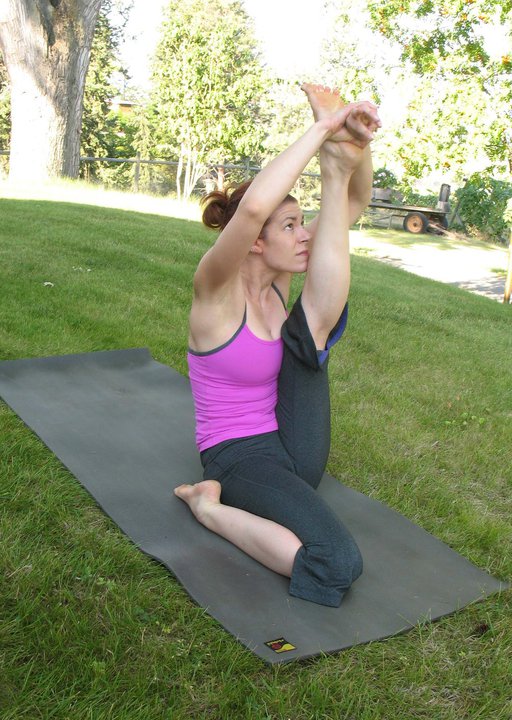 |
| If you try this in a “hot yoga” class you may tear your hamstring. But that doesn’t mean you can’t practice yoga. |
The Primary Series of Ashtanga is known as the “healing series”, something I truly believe because it healed me. So why is yoga wrecking bodies, as the article suggests?
 |
| If you have back problems, don’t do backbends. You can still practice yoga. |
First, I think we need to address the matter of semantics. Differences in connotations and personal interpretations can really fire up an argument. I can tell you I used to get irrationally annoyed when people would refer to their toddlers’ daycare centre as “school”. Honestly, did it matter what anyone called it? Did it make a difference? No. But yet I would be bothered always by the switch in title.
And this is why simply using the word “yoga” in such a sweeping way bothers me. What I think of as yoga and what the article is talking about are two very different things.
When I first started at my studio, a teacher said to me “There is a difference between going to yoga classes and having a yoga practice.” And there, exactly, is the point. Going to a yoga class and treating it as a kick ass workout – that is where the injuries happen. Competition, ego, and envy are injury instigators. Pressure from inferior teachers who don’t know individual bodies and limitations leads to injuries. Attempting difficult or complicated postures in a crowded, sweaty room without first obtaining the proper knowledge, strength, and flexibility is an injury waiting to happen. Turning your attention outward instead of inward, not paying attention to your body and what it is telling you, letting what happened yesterday affect your feelings about today can lead to pain and injury.
 |
|
You can’t learn this in a led class. You need a teacher to help you, one-on-one. But that doesn’t mean you can’t practice yoga. |
In Mysore-style Ashtanga, students practice the sequence of postures at their own pace with a teacher to assist and adjust them properly. The benefit of this style is that you do not go past your own limitations; you do not move to the next posture until you can properly and safely perform the previous postures. The teacher deems you to be ready when you are ready. The teacher works with you one-on-one and learns your body and your strengths and weaknesses. As an example, here is a video showing this style of yoga (fun fact: I am wearing a pale pink top and light grey tights – can you spot me?)
But posture – or asana – is only one of eight limbs of Ashtanga. Only one. Of utmost importance is the limb of ahimsa, which means non-harming. This includes non-harming to ones’ self. My beloved teacher is known to say “Do this posture at the expense of absolutely nothing.” Taking this advice eliminates the possiblity of yoga wrecking your body. He also says “You want to do this your whole life.” I do. So I draw my attention inward.
The other limbs include breath control, inner peace and inner observation, and living ethically. It doesn’t really matter if you can hold your leg behind your head then float back to chaturanga if you roll up your mat and resume your life as an asshole. That’s not yoga. Sri K. Pattabhi Jois, the Guruji of Ashtanga yoga, said that yoga is for ALL people, except for lazy people. I really believe that. I have a friend who is featured in this video; he is amazing, he has a beautiful practice, I am inspired to be in his presence. But also inspiring are all the people I see every day, every morning at yoga practice, all those people in the previous video. Our practices all look different; our bodies are all different, but we are all there, with intention. From the very beginner who struggles through sun salutations to the very advanced practitioner who takes my breath away with their physical stamina; those people who are true to themselves and their practice, those who live an ethical, compassionate life, those who cultivate patience and kindness, those people are true yogis and are inspirational, always.
Practicing asana is important – it gives concentration, it gives physical strength and stamina, but of greater importance is to live the yoga, to take it off the mat and live a life of compassion and inner reflection and non-harming – to others and to yourself. That is yoga, true yoga, and it cannot wreck your body.