This weekend I spent some time reading articles about the Little House on the Prairie books, and how Rose Wilder Lane, one of the founders of what is known as modern Libertarianism and also Laura Ingalls Wilder’s daughter, heavily edited the original manuscripts in order to further her political agenda. I knew this already, to some extent. After all, there is a lot of discussion, mostly from Pa, about being free and independent and about how you can never depend on anyone but yourself. God helps those who help themselves, pull yourself up by your boot straps, et cetera. I was surprised to find, however, that certain details have been changed, hypocritically, that are absolutely central to the story. I knew that the Ingalls family had illegally squatted on land in what is now Kansas, “Indian Territory” land that belonged to the native people and that was not up for settlement, no matter how huffy Pa got at the end of Little House on the Prairie. “I’ll not stay here to be taken away by the soldiers like an outlaw!” Ah, Pa, but an outlaw you were.
What I didn’t know was that Mary’s education at the Iowa College for the Blind was paid for by the government of Dakota. That’s a pretty major detail, since in all the books Laura was teaching school in wretched conditions at a very young age, in order to earn money to send and keep Mary at college. I guess that what poor Laura was doing was earning money just to help keep her family from being completely impoverished and destitute. Poor Laura! Living in that shack in the middle of the god-forsaken prairie, forty below with the wind always blowing and the snow so deep that walking to the schoolhouse was almost beyond her strength, staying with a homicidal woman who threatened her husband with a knife and who was almost certainly suffering from deep depression. Not that I blame her. Mrs. Brewster, the least understood woman in the history of the Little House books. If I were stuck in a similar situation, where my days were spent entirely a) sweeping out the one-room shack, b) cooking two meals a day that consist only of potatoes and salt pork, and c) maybe doing the laundry when it wasn’t minus 40, I’d probably want to murder someone too. And yet, Laura went through this to help with the family’s terrible financial situation, and not to merely send her sister to school. Depressing indeed.
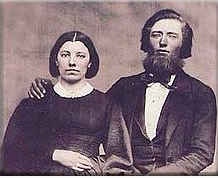
I recently read a book about the Ingalls family; I’ve always kind of wondered about long-suffering Ma, who essentially packed up the family with a cheery countenance any time her crazy husband decided to pick up and move cross-country. Was Ma constantly on laudanum? Or was she some kind of earthly angel? Here’s the depressing answer: Caroline was getting kind of old-maidish – she was a schoolteacher, as well – and Charles was considered to be extremely handsome and dashing. His proposal to schoolmarmish Caroline was a huge surprise to friends and family, who did not think that she was his equal in attractiveness and spirit. THEY DID NOT THINK SHE WAS PRETTY ENOUGH FOR CHARLES. Take a look at this picture and see for yourself:
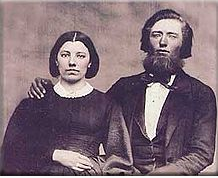
Perhaps it’s my bias against Old Crazy Blue Eyes, but I think it’s Ma who has the looks in that family. We all know couples who don’t “match”, as it were, but I don’t think it’s PA who has stooped beneath him here. Well, we all know the depressing truth of the matter, and that is that women’s appearances have always been a kind of currency. Apparently Caroline did not have enough currency to afford herself a non-crazy husband. But I digress: discussions of women and their worth as a person vis a vis their personal appearance shall appear on another blog post. See also: future discussion of Sense and Sensibility.
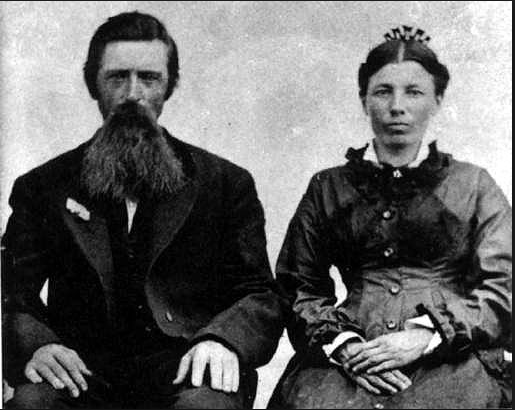
Ugh, I’m sure that was a styling beard at the time but I find it repugnant. Of course, I freely (and independently!) admit my bias against facial hair, given that I even found Jon Hamm’s Emmy beard to be repulsive. This is a matter of personal opinion, of course, and I know there are a lot of you out there who dig the mountain man, or at least the stubbly, look.
None of this, of course, bothered me when I was a child. I read those books cover to cover many times and I was absolutely enchanted by the pioneer lifestyle. It didn’t occur to me that those ten hour drives to visit my grandparents in the back of a sedan with two brothers, a dog, and all our toys and books to keep us occupied for that time was nothing compared with riding in a covered wagon for months at a time. It didn’t occur to me that if something happened to Pa when he was walking hundreds of miles to find work because he borrowed money he couldn’t pay back to build a fancy house – with glass windows and an actual stove – or when he went to buy supplies somewhere in Kansas, or any other time, that life would go from dreary to desperate in a flash. It would be all the worse for a woman left alone with four young girls in the middle of nowhere. Back then, if something had happened to Pa, the very best option Ma would have had would be to marry someone, anyone, and she would be forever beholden to whomever would take on such a burden, as it were. It’s a very sad thought, to be sure. I guess Crazy Pa was better than No Pa At All.
What did occur to me, as a child, was that Mary, with her golden curls, was much more beautiful than Laura, with her straight brown hair. This is what I looked like at age seven:
Notice I’m reading Little Town on the Prairie; maybe Almanzo has touched Laura’s mitten tip. Anyway, please note that my hair is BROWN and STRAIGHT. This is the message from the Little House books: blonde = beautiful, brunette = ugly. I may be sensitive to this since my best friend at the time had gorgeous, thick, wavy, white blonde hair. Wherever we went, her hair was commented on and gushed over. I have never gotten over that, apparently, since my hair issues could fill a book.
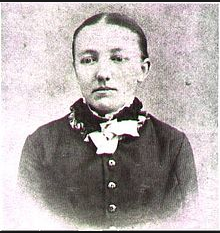
In reality, though, this is Laura:
and this is Mary:
Draw whatever conclusions you will, but I think Laura sells herself a bit short, no?